




Sponsored: Turning Uncertainty into Action: Sherri’s ORSERDU Experience
Important Patient Facts | Important Safety Information | Full Prescribing Information
For postmenopausal women and adult men with ESR1-mutated, ER+/HER2- advanced or metastatic breast cancer whose disease has progressed on endocrine therapy
Progression left Sherri with a lot of uncertainty and a lot of questions. But when she spoke to her oncologist and learned there was a treatment option specifically for her type of cancer? One that gave her hope? It was the information she needed to hear.
Facing challenges as a team
At 54 years old, Sherri had been living with breast cancer for more than 15 years. She’d learned how to navigate life in a new way. Sherri continued to work full time, had three grown children, and she had strong, close friendships. Even when her cancer had become metastatic, she did not let it derail her life completely. She'd learned long ago how to advocate for herself and for her treatment.
During a routine oncologist appointment, Sherri learned her cancer had spread again. Her treatment was no longer working. It felt like a breaking point. She wondered: What options do I have?
Sherri was never one to give in easily. She knew knowledge was powerful. She discussed next steps with her oncologist and they made a plan together.
One test. A renewed path forward.
Sherri’s oncologist ordered a blood test (sometimes called a liquid biopsy) to learn why the cancer had progressed. Her doctor was looking for a mutation called ESR1.

Nearly 1 out of 2 people with ER+/HER2- advanced or metastatic breast cancer develop an ESR1 mutation.
ESR1 mutations are a way that cancer cells try to get around treatment and continue growing. Liquid biopsy is the preferred method for detecting ESR1 mutations.
For Sherri, the blood test results showed that her cancer had developed an ESR1 mutation. This meant she was eligible for a different treatment option, one specifically for her type of cancer: ORSERDU.
ORSERDU was the right treatment for Sherri

ORSERDU was the first FDA-approved treatment to target ESR1 mutations. And it's made a difference for people living with ER+/HER2- advanced or metastatic breast cancer that has progressed on endocrine therapy.
Since it was approved in January 2023, more than 16,000 people have been prescribed ORSERDU for this type of ESR1-mutated breast cancer.
In the clinical trial, ORSERDU helped people live 2x longer without their cancer spreading or getting worse. For Sherri, these results were more than numbers. ORSERDU meant more time with her family while delaying the challenges that can come with chemotherapy.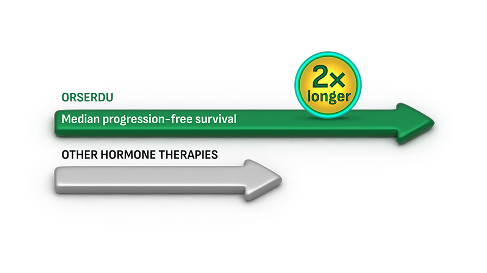
This was measured by median progression-free survival (mPFS). In a clinical trial, mPFS measures the point in time when half of the people were living without their disease spreading or getting worse. On ORSERDU, the mPFS for people with ESR1-mutated cancer was 3.8 months. On other commonly prescribed hormone therapies (such as exemestane, anastrozole, letrozole, and fulvestrant), the mPFS was 1.9 months. Individual results may vary.
| The most common side effects of ORSERDU include: | |
|---|---|
|
|
If you develop certain side effects, your healthcare provider may decrease your dose, temporarily stop, or completely stop treatment with ORSERDU.
Taking ORSERDU with food can help reduce nausea. Talk to your doctor if you have questions about these side effects. You may report side effects to the FDA at 1-800-FDA-1088.
ORSERDU fit into Sherri’s routine
While Sherri was taking ORSERDU, her treatment fit into her life. She had a routine every morning: coffee, big breakfast, and her ORSERDU pill. Then, she went about her day. Everyone’s experience with ORSERDU can be different. But for Sherri, ORSERDU was the 1 for her.
Sherri cares deeply about helping other people living with breast cancer. She is active in patient advocacy groups and in the ORSERDU ambassador program. And she knows that when people share their stories, they help inspire others living with uncertainty.
Sherri wants everyone to know: You are not a statistic. Statistics look at what has been accomplished in the past. You are looking to the future. You are living with strength. And you are redefining what is possible in metastatic breast cancer.

If you are facing progression, ask about a blood test for ESR1 mutations. Sherri says: “Demand it!” Knowing why your cancer has changed can help personalize your next treatment.
Talk to your doctor to see if ORSERDU could be the 1 for you.
Watch real ORSERDU stories

ER+, estrogen receptor-positive; ESR1, estrogen receptor 1; HER2-, human epidermal growth factor receptor 2-negative.
INDICATION
ORSERDU (elacestrant) is a prescription medicine to treat women who have gone through menopause and adult men with estrogen receptor (ER)-positive, human epidermal growth factor receptor 2 (HER2)-negative, ESR1-mutated advanced breast cancer or breast cancer that has spread to other parts of the body (metastatic), and whose disease has progressed after endocrine therapy.
Your healthcare provider will perform a test to make sure that ORSERDU is right for you.
It is not known if ORSERDU is safe and effective in children.
IMPORTANT SAFETY INFORMATION
ORSERDU may cause serious side effects, including:
- Increased fat (lipid) levels in your blood (hypercholesterolemia and hypertriglyceridemia). Your healthcare provider will do blood tests to check your lipid levels before and during your treatment with ORSERDU
Before taking ORSERDU, tell your healthcare provider about all your medical conditions, including if you:
- Have liver problems
- Are pregnant or plan to become pregnant. ORSERDU can harm your unborn baby
Females who are able to become pregnant:
- Your healthcare provider may do a pregnancy test before you start treatment with ORSERDU
- You should use effective (contraception) birth control during treatment with ORSERDU and for 1 week after the last dose
- Tell your healthcare provider right away if you become pregnant or think you may be pregnant during treatment with ORSERDU
Males with female partners who are able to become pregnant:
- You should use effective (contraception) birth control during treatment with ORSERDU and for 1 week after the last dose
- Are breastfeeding or plan to breastfeed. It is not known if ORSERDU passes into your breast milk. Do not breastfeed during treatment with ORSERDU and for 1 week after the last dose
Tell your healthcare provider about all the medicines you take, including prescription and over-the-counter medicines, vitamins, and herbal supplements. ORSERDU and other medicines may affect each other causing side effects. Know the medicines you take. Keep a list of them to show your healthcare provider or pharmacist when you get a new medicine.
| The most common side effects of ORSERDU include: | |
|---|---|
|
|
Your healthcare provider may decrease your dose, temporarily stop, or completely stop treatment with ORSERDU, if you develop certain side effects.
ORSERDU may affect fertility in males and in females who are able to become pregnant. Talk to your healthcare provider if this is a concern for you.
ORSERDU is available as 345 mg and 86 mg tablets.
These are not all the possible side effects of ORSERDU. Call your doctor for medical advice about side effects. You may report side effects to the FDA at 1-800-FDA-1088 or visit www.fda.gov/medwatch.

Please see Important Facts about ORSERDU.
ORSERDU is a registered trademark of the Menarini Group.
© 2026 Stemline Therapeutics, Inc., a Menarini Group Company.
All rights reserved. 07/26 MAT-US-ELA-01537